2026, October 9th
MAMFT Annual Conference
Digital Intimacy/Dependency
Ethical and experiential conversations on AI, loneliness, and clinical judgment
ABOUT
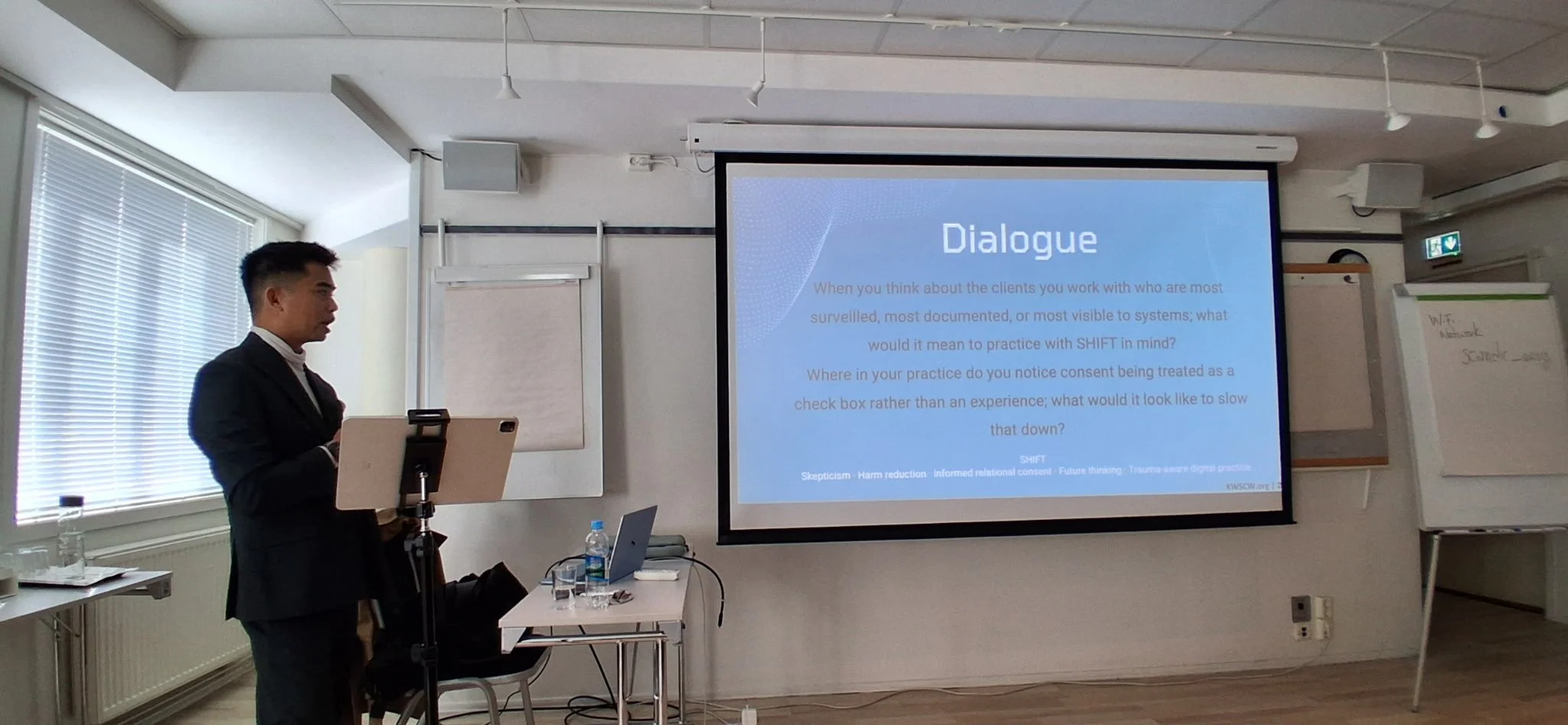
Thank you for scanning the QR code at the annual conference!
Below are some of the references and resources that were discussed and utilized throughout this presentation as of October 9, 2026.
Note: due to the nature of AI and its development, some of these references and resources may be outdated.
References
American Association for Marriage and Family Therapy. (2026). AAMFT code of ethics. https://www.aamft.org/AAMFT/web/Action-Advocacy/Code-of-Ethics-New.aspx aamft.org
Anthropic. (2025, April 24). Exploring model welfare. https://www.anthropic.com/research/exploring-model-welfare anthropic.com
Business Insider. (2026). Him: Life with my AI boyfriend [Video]. YouTube. https://www.youtube.com/watch?v=sKQbArT36AU
Chiu, H.-C., & Foote, J. (2026). Chatting with confidants or corporations? Privacy management with AI companions. Journal of Computer-Mediated Communication, 31(4), Article zmag014. https://doi.org/10.1093/jcmc/zmag014 Oxford Academic
De Freitas, J., Oğuz-Uğuralp, Z., Uğuralp, A. K., & Puntoni, S. (2026). AI companions reduce loneliness. Journal of Consumer Research, 52(6), 1126–1148. https://doi.org/10.1093/jcr/ucaf040 Oxford Academic
Fang, C. M., Liu, A. R., Danry, V., Lee, E., Chan, S. W. T., Pataranutaporn, P., Maes, P., Phang, J., Lampe, M., Ahmad, L., & Agarwal, S. (2025). How AI and human behaviors shape psychosocial effects of extended chatbot use: A longitudinal randomized controlled study (Version 2) [Preprint]. arXiv. https://doi.org/10.48550/arXiv.2503.17473 arxiv.org
Hennepin County. (2022, December 14). Hennepin County land and water acknowledgement and tribal flag lending library. https://content.govdelivery.com/accounts/MNHENNE/bulletins/33c7b4e content.govdelivery.com
Hertlein, K. M., & Springer, P. (2026). Artificial intelligence in couple and family therapy: Introduction of the AI competencies. Journal of Marital and Family Therapy, 52(2), Article e70121. https://doi.org/10.1111/jmft.70121 PubMed
Hertlein, K. M., & Twist, M. L. C. (2018). Attachment to technology: The missing link. Journal of Couple & Relationship Therapy, 17(1), 2–6. https://doi.org/10.1080/15332691.2017.1414530 oasis.library.unlv.edu
IBM Technology. (2023, November 10). The 7 types of AI—and why we talk (mostly) about 3 of them [Video]. YouTube. https://www.youtube.com/watch?v=XFZ-rQ8eeR8
International Energy Agency. (2025). Energy and AI. https://www.iea.org/reports/energy-and-ai IEA
Kuang, J., Pope, A. L., & Zhang, Y. (2026). Psychotherapists’ trust, distrust, and generative AI practices in psychotherapy: Qualitative study. Journal of Medical Internet Research, 28, Article e88932. https://doi.org/10.2196/88932 PMC
McArthur, N., & Twist, M. L. C. (2017). The rise of digisexuality: Therapeutic challenges and possibilities. Sexual and Relationship Therapy, 32(3–4), 334–344. https://doi.org/10.1080/14681994.2017.1397950 Get Access
McDowell, T., Knudson-Martin, C., & Bermúdez, J. M. (2023). Socioculturally attuned family therapy: Guidelines for equitable theory and practice (2nd ed.). Routledge. Routledge
Metropolitan Council. (2025, April 22). Metro update: More bus service, Met Council candidate interviews, restoring land and water. https://content.govdelivery.com/accounts/MNORGMETC/bulletins/3dc40cc content.govdelivery.com
Native Governance Center. (2021). Beyond land acknowledgment: A guide. https://nativegov.org/resources/beyond-land-acknowledgment-a-guide/ Native Governance Center
Office of the Surgeon General. (2023). Our epidemic of loneliness and isolation: The U.S. Surgeon General’s advisory on the healing effects of social connection and community. U.S. Department of Health and Human Services. https://www.hhs.gov/sites/default/files/surgeon-general-social-connection-advisory.pdf
Skeide, K. (2026). Artificial intelligence companionship, loneliness, and relational health in emerging adults [Manuscript submitted for publication].
Strachan, J. W. A., Albergo, D., Borghini, G., Pansardi, O., Scaliti, E., Gupta, S., Saxena, K., Rufo, A., Panzeri, S., Manzi, G., Graziano, M. S. A., & Becchio, C. (2024). Testing theory of mind in large language models and humans. Nature Human Behaviour, 8(7), 1285–1295. https://doi.org/10.1038/s41562-024-01882-z Princeton University
Stryker, C. (2021, October 6). What are large language models (LLMs)? IBM. https://www.ibm.com/think/topics/large-language-models IBM
SXSW. (2023). Esther Perel on the other AI: Artificial intimacy | SXSW 2023 [Video]. YouTube. https://www.youtube.com/watch?v=vSF-Al45hQU SXSW 2023
Turkle, S. (2011). Alone together: Why we expect more from technology and less from each other. Basic Books. Massachusetts Institute of Technology
Turkle, S. (2026). Artificial intimacy: Who we become when we talk to machines. Little, Brown and Company. Hachette Book Group
Twist, M. L. C., & McArthur, N. (2020). Introduction to special issue on digihealth and sexual health. Sexual and Relationship Therapy, 35(2), 131–136. https://doi.org/10.1080/14681994.2020.1735176
United Nations Environment Programme. (2025, November 13). AI has an environmental problem. Here’s what the world can do about that. https://www.unep.org/news-and-stories/story/ai-has-environmental-problem-heres-what-world-can-do-about unep.org
Yang, F., & Oshio, A. (2025). Using attachment theory to conceptualize and measure the experiences in human-AI relationships. Current Psychology, 44, 10658–10669. https://doi.org/10.1007/s12144-025-07917-6 Springer
Videos to watch
Business Insider. (2026). Him: Life with my AI boyfriend [Video]. YouTube. https://www.youtube.com/watch?v=sKQbArT36AU
Darling, K. (2018, September). Why we have an emotional connection to robots [Video]. TED Conferences. https://www.ted.com/talks/kate_darling_why_we_have_an_emotional_connection_to_robots TED Talk
IBM Technology. (2023, November 10). The 7 types of AI—and why we talk (mostly) about 3 of them [Video]. YouTube. https://www.youtube.com/watch?v=XFZ-rQ8eeR8
SXSW. (2023). Esther Perel on the other AI: Artificial intimacy | SXSW 2023 [Video]. YouTube. https://www.youtube.com/watch?v=vSF-Al45hQU SXSW 2023
Turkle, S. (2012, February). Connected, but alone? [Video]. TED Conferences. https://www.ted.com/talks/sherry_turkle_connected_but_alone TED Talk
Hikikomori: Recommended resources
Kato, T. A., Kanba, S., & Teo, A. R. (2019). Hikikomori: Multidimensional understanding, assessment, and future international perspectives. Psychiatry and Clinical Neurosciences, 73(8), 427–440. https://doi.org/10.1111/pcn.12895 Wiley Online Library
Kato, T. A., Kanba, S., & Teo, A. R. (2020). Defining pathological social withdrawal: Proposed diagnostic criteria for hikikomori. World Psychiatry, 19(1), 116–117. https://doi.org/10.1002/wps.20705 Wiley Online Library
Saitō, T. (2013). Hikikomori: Adolescence without end (J. Angles, Trans.). University of Minnesota Press. (Original work published 1998). https://www.upress.umn.edu/9780816654598/hikikomori/ upress.umn.edu
Teo, A. R., Chen, J. I., Kubo, H., Katsuki, R., Sato-Kasai, M., Shimokawa, N., Hayakawa, K., Umene-Nakano, W., Aikens, J. E., Kanba, S., & Kato, T. A. (2018). Development and validation of the 25-item Hikikomori Questionnaire (HQ-25). Psychiatry and Clinical Neurosciences, 72(10), 780–788. https://doi.org/10.1111/pcn.12691 PubMed
Teo, A. R., & Gaw, A. C. (2010). Hikikomori, a Japanese culture-bound syndrome of social withdrawal? A proposal for DSM-5. The Journal of Nervous and Mental Disease, 198(6), 444–449. https://doi.org/10.1097/NMD.0b013e3181e086b1 Oregon Health & Science University
AI and human relationships: Recommended resources
Chiu, H.-C., & Foote, J. (2026). Chatting with confidants or corporations? Privacy management with AI companions. Journal of Computer-Mediated Communication, 31(4), Article zmag014. https://doi.org/10.1093/jcmc/zmag014 Oxford Academic
De Freitas, J., Oğuz-Uğuralp, Z., Uğuralp, A. K., & Puntoni, S. (2026). AI companions reduce loneliness. Journal of Consumer Research, 52(6), 1126–1148. https://doi.org/10.1093/jcr/ucaf040 Oxford Academic
Fang, C. M., Liu, A. R., Danry, V., Lee, E., Chan, S. W. T., Pataranutaporn, P., Maes, P., Phang, J., Lampe, M., Ahmad, L., & Agarwal, S. (2025). How AI and human behaviors shape psychosocial effects of extended chatbot use: A longitudinal randomized controlled study (Version 2) [Preprint]. arXiv. https://doi.org/10.48550/arXiv.2503.17473 arxiv.org
Hertlein, K. M., & Springer, P. (2026). Artificial intelligence in couple and family therapy: Introduction of the AI competencies. Journal of Marital and Family Therapy, 52(2), Article e70121. https://doi.org/10.1111/jmft.70121 PubMed
Yang, F., & Oshio, A. (2025). Using attachment theory to conceptualize and measure the experiences in human-AI relationships. Current Psychology, 44, 10658–10669. https://doi.org/10.1007/s12144-025-07917-6 Springer
Philosophy, ethics, and human-machine relationships: Recommended resources
Coeckelbergh, M. (2020). AI ethics. MIT Press. https://doi.org/10.7551/mitpress/12549.001.0001 MIT Press
Danaher, J., & McArthur, N. (Eds.). (2017). Robot sex: Social and ethical implications. MIT Press. https://doi.org/10.7551/mitpress/9780262036689.001.0001 Oxford Academic
Gunkel, D. J. (2012). The machine question: Critical perspectives on AI, robots, and ethics. MIT Press. https://doi.org/10.7551/mitpress/8975.001.0001 MIT Press
Gunkel, D. J. (2018). Robot rights. MIT Press. https://mitpress.mit.edu/9780262038621/robot-rights/ mitpress.mit.edu
Turkle, S. (2011). Alone together: Why we expect more from technology and less from each other. Basic Books.