A Philosophy of Teaching
My teaching is relational, reflective, and attentive to power. Across courses, professional trainings, and curriculum development, I ask learners to examine their assumptions, stay with complexity, and consider what knowledge does once it enters clinical practice and public life. I design learning spaces around care, accountability, and access, recognizing that learning is shaped not only by individual effort but also by institutions, histories, relationships, and the conditions people carry into the room.
“Teaching and learning are never neutral. Every classroom carries assumptions about whose knowledge counts, what mastery looks like, and which forms of distress can be seen. My task is to make those assumptions available for examination while creating enough trust for people to remain present through discomfort. No one should have to perform wellness or mastery to be taken seriously as a learner. Knowledge can emerge through uncertainty, rupture, silence, grief, and joy.”
On Magic: A Reflection
Calling these times unprecedented no longer tells us much. What matters is whether we can think critically about how we meet the world and the people with whom we share it. Teaching is one of the places where those relationships are formed, where knowledge is offered, questioned, translated, and made accountable. Yet teaching never exists apart from institutions, and institutions deteriorate when they are treated as permanent rather than tended as living systems. To teach, then, is to inherit a room and accept responsibility for what it permits, whom it holds, and what becomes possible within it.
As I write in my reflection, “It is often in repair that we discover the strength-based parts of connection: the capacity to stay, revise, apologize, clarify, and remain accountable after knowledge has done what knowledge often does, which is to transform the people who encounter it.” This is the kind of teaching I hope to continue practicing: teaching grounded in rigor and care, but also in the willingness to remain present when learning produces conflict, discomfort, or change. Like the teachers who fostered in me not only knowledge but a sense of duty toward what knowledge can make possible, I want to carry that inheritance forward by building relationships, sharing knowledge, and helping make education worthy of the reverence so many of us were taught to give it.
Featured Highlights
Asynchronous teaching
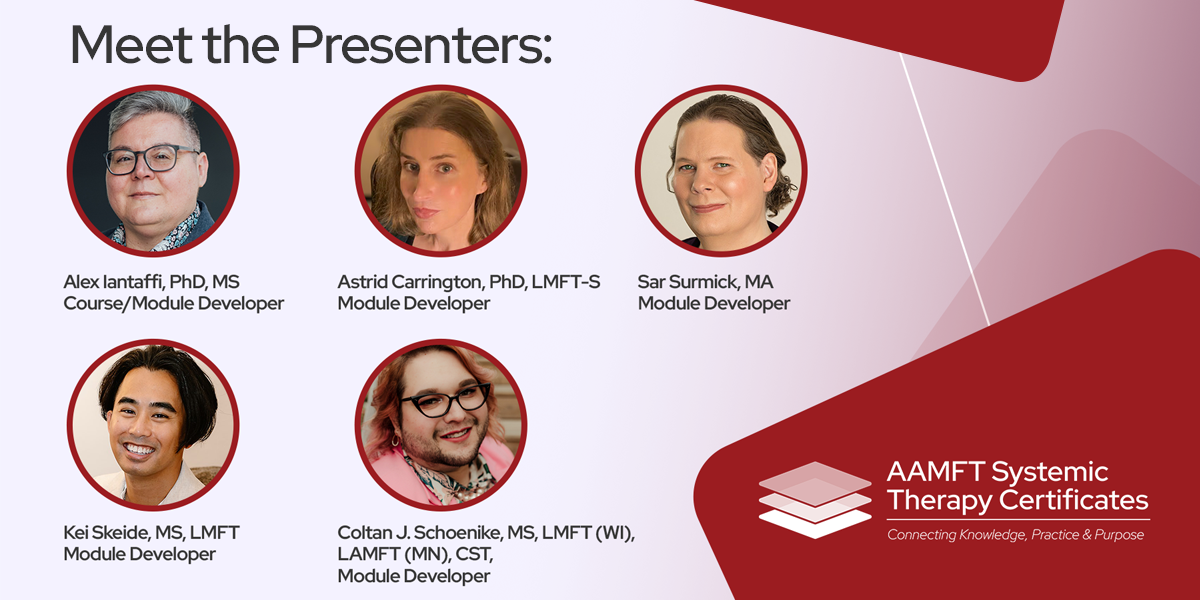
AAMFT Systemic Therapy Certificate Contributions
As part of my teaching portfolio, I include my work as a module developer for AAMFT’s asynchronous Systemic Therapy Certificate programming.
My contributions focus on two primary areas: the systemic foundations of gender-affirming care and the forthcoming systemic assessment of artificial intelligence use by clients.
Across these certificate programs, I translate emerging clinical, ethical, and sociopolitical concerns into accessible training materials for systemic therapists. This work demonstrates my capacity to design asynchronous professional education that helps clinicians think critically about gender-affirming care, client use of AI, current digital relational trends, and the responsibilities practitioners carry as technology and law continue to reshape clinical practice.
Synchronous Teaching
Sexual Consent & Coercion
July, 2026
As part of my teaching portfolio, I include a synchronous teaching excerpt from my work as instructor support for the University of Guelph’s Foundations in Professional Sexuality Practices course. This online intensive course trains clinicians, educators, and other helping professionals in foundational sexuality practice, with attention to ethics, consent, relational systems, and sociocultural context.
In this clip, I lecture and facilitate discussion on sexual consent with advanced and early-career clinicians, drawing on material situated within the Canadian legal and professional context. Using slides, chat-based reflection, polling, and applied scenarios, the segment demonstrates my ability to teach sensitive clinical material in real time, engage learners actively, and help practitioners examine basic consent, affirmative consent, ambiguity, intoxication, relational power, and ethical decision-making in sexuality practice.
Other Notable Artifacts
CFT 6961: CFT Internship I
The linked syllabus was developed for MFT students entering their first practicum/internship experience and expanded from a general base syllabus to better reflect the realities of early clinical training beyond private-practice settings. Portions of the course were co-constructed and revised throughout the semester in response to students’ emerging needs, consistent with Prouty’s (2015) emphasis on process-centered, learner-responsive course development; subsequent semesters continued this same iterative approach, with the syllabus adapting to each cohort rather than remaining fixed. Particular attention was given to boundary setting as a clinical and professional competency, including not only boundaries with clients but also the development of sustainable expectations, limits, and practices for oneself as a beginning therapist.
Reference
Prouty, A. M. (2015). Co-constructing courses with marriage and family therapy (MFT) graduate students: Favoring process over content. Journal of Family Psychotherapy, 26(2), 122–138. https://doi.org/10.1080/08975353.2015.1038966
The Necessity of Critical Thinking in MFT Education
Written for CFT 7200: Teaching, Consultation, and Leadership, this paper begins from a simple conviction: critical thinking is not an ornamental academic skill, but a way of remaining awake to the systems that shape what we teach, whom we treat, and what we call competence. In the United States, where education and healthcare are increasingly strained by polarization, inequity, and anti-intellectualism, I argue that reflective, relational inquiry is essential to ethical practice.
“Without enough time to think, reflect, and embody, even well-intentioned practitioners default to scripts and compliance.
In therapy and in education, meaningful change requires time.”

Dialectical Behavioral Therapy Skills Trainings for Queer Folx (18+)
Although this is not a traditional academic course, I approach the 12-week Queer DBT Skills Training Group as a structured learning experience in which participants develop skills through both written, evidence-based materials and repeated experiential practice. The group has been running since Fall 2023. Before each cycle, I meet individually with participants through an onboarding process to better understand their presenting concerns, relational dynamics, and learning needs; I then use this information to shape portions of the curriculum while maintaining the core DBT areas of mindfulness, distress tolerance, emotion regulation, and interpersonal effectiveness. The sample syllabus and session agenda shown on the public facing introduction page illustrate this process, with each cycle organized responsively around the particular group rather than delivered as an identical, fixed curriculum.